
Organizing school homework: how a school stops it piling up on one day
A practical guide to organizing school homework: how much time each grade needs, spreading it across the week, what to write in it and who handed it in.

On Thursday evening, an eighth grader opens his school bag to find four assignments due on Sunday morning: maths exercises, a science report, an Arabic composition and two pages of English vocabulary. None of his four teachers knew what the others had assigned. His parents only find out from him, late on Saturday night, and by Sunday morning the teachers discover that half the section has left the work unfinished. The problem is not homework itself. It is that nobody organizes school homework across the whole school, so every teacher decides in isolation what to assign and when it is due.
How does a school organize homework?
The short answer: a school organizes homework with a written policy that sets a daily time limit for each grade, spreads each subject's homework across the week in a plan for every section, and requires every assignment to carry a clear due date and instructions both students and parents can understand. Each week, the homeroom teacher reviews the hand-in record and contacts the parents whenever a student repeatedly falls behind.
How much time should school homework take in each grade?
Many educators follow what is known as the ten-minute rule: a student spends about ten minutes a day on all their homework for each grade they have reached, so a first grader needs ten minutes and a sixth grader about an hour. Crucially, this limit covers all subjects combined rather than a single subject, which means a school can only keep to it when the teachers of each section coordinate.
| Grades | Suggested daily time for all homework |
|---|---|
| 1 and 2 | 10 to 20 minutes |
| 3 and 4 | 30 to 40 minutes |
| 5 to 7 | 50 to 70 minutes |
| 8 and 9 | 80 to 90 minutes |
| Secondary grades | About two hours, with room for exam-year subjects |
A school can adjust these figures to suit its students, as long as it writes them into its policy and shares them with teachers and parents alike. Teachers then know the limit they are working to, and parents know what to expect from their child at home.
How should a school spread homework across the week?
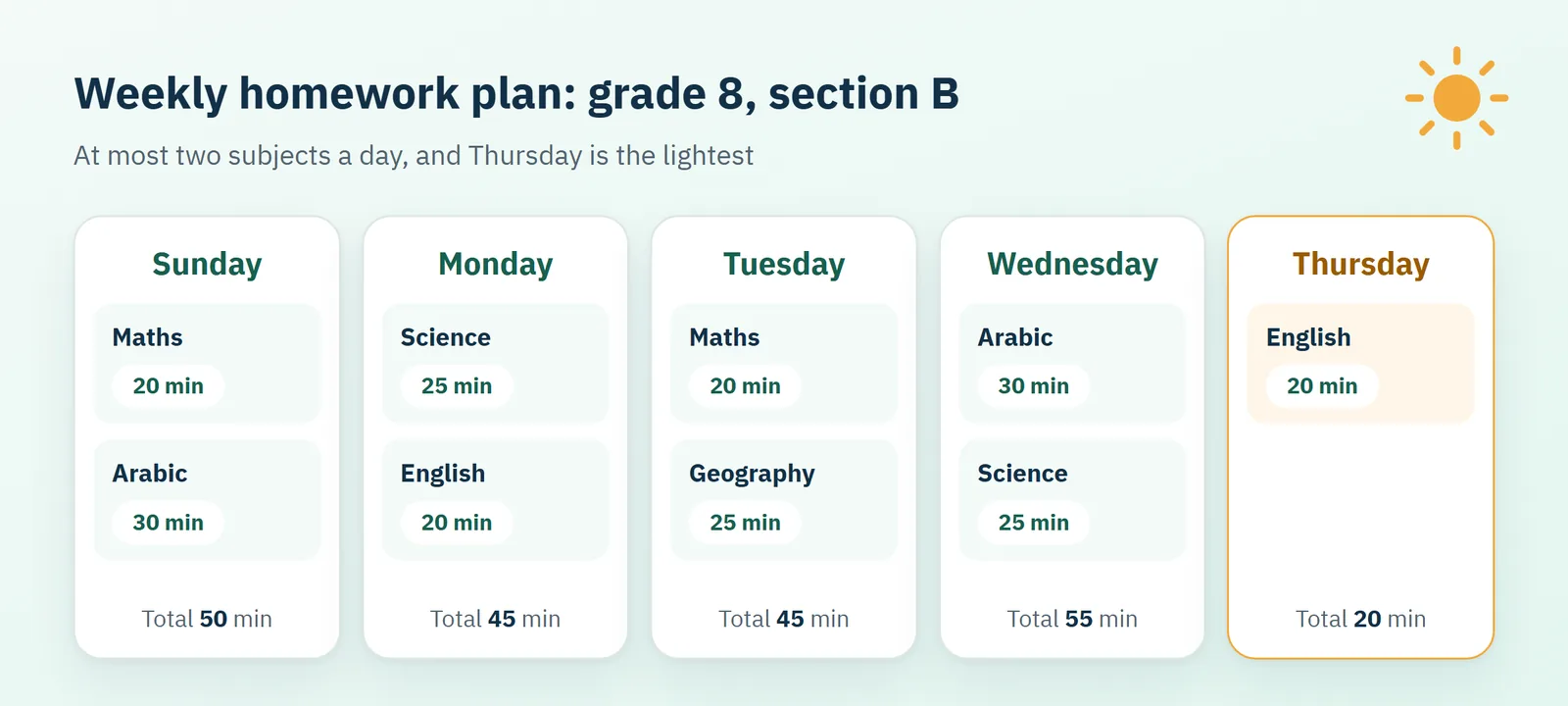
The most reliable way to stop homework piling up is for the homeroom teacher, working alongside the supervisor, to build a weekly homework plan for each section, based on the weekly timetable and guided by these rules:
- Fixed days for each subject: homework is assigned in the subject's period and collected at its next period, so students always know in advance what is due each day.
- A daily ceiling: no more than two major assignments are due on the same day; anything beyond that shifts to another day by agreement among the teachers.
- The weekend: a section gets no more homework on Thursday than on any other day, so the two-day weekend does not turn into two more working days.
- Test week: homework is scaled back in the week of the tests, so students have the time they need at home to revise.
What should a homework assignment say so students and parents understand it?
A clear assignment lets a parent follow along without having to ask their child what the teacher meant. To achieve that, every assignment includes five things: the subject and section, exactly what is required with page and exercise numbers, the due date with its day, the expected time it takes, and how to hand it in. The templates below are ready to copy.
Template for a daily assignment
Maths, grade 8 section B: solve exercises 3, 4 and 5 on page 62. Due: Sunday 29/11/2026. Expected time: 20 minutes. Hand in your answers in your exercise book at the first maths period.
Template for a week-long assignment
Science, grade 8 section B: a one-page report on the water cycle, with a diagram. Due: Thursday 3/12/2026. Expected time: one hour, spread over the week. Upload a photo of the report from your student account or hand it in on paper.
Template message to a parent when homework keeps being missed
Mrs Rana Al-Ahmad, your son Omar has not handed in three pieces of homework this week, in maths and science. Please follow this up with him; for any questions, contact his homeroom teacher. The school office.
How does a school keep track of who handed homework in?
Homework loses its value the moment students realize nobody is checking it, which is why consistent follow-up rests on three clear steps:
- Marking before the next assignment: the teacher marks and returns the homework, or records its mark, before setting the section a new assignment in the same subject, showing students that their effort counts.
- A weekly check by the homeroom teacher: every Thursday, the homeroom teacher reviews the hand-in record for their section across all subjects. Missing a single assignment calls for a quick reminder, while missing three in a week, or repeatedly missing the same subject, calls for contacting the parents.
- Looking for patterns across the section: when half a section misses the same assignment, the reason is usually that the task was too long or poorly explained, so the supervisor reviews it with the subject teacher rather than penalizing the students.
A checklist for your school's homework policy
- Daily time for each grade: written into the policy and shared with teachers and parents.
- A weekly plan for each section: drawn up by the homeroom teacher and the supervisor from the weekly timetable.
- A daily ceiling: at most two major assignments due on the same day.
- Fixed elements in every assignment: what is required, the due date, the expected time and how to hand it in.
- Marking before the next assignment: in every subject and every section.
- A review every Thursday: the hand-in record for each section, and a call to parents when missed work repeats.
- Lighter homework in test week: announced to teachers before the week begins.

How does Shams make organizing school homework easier?
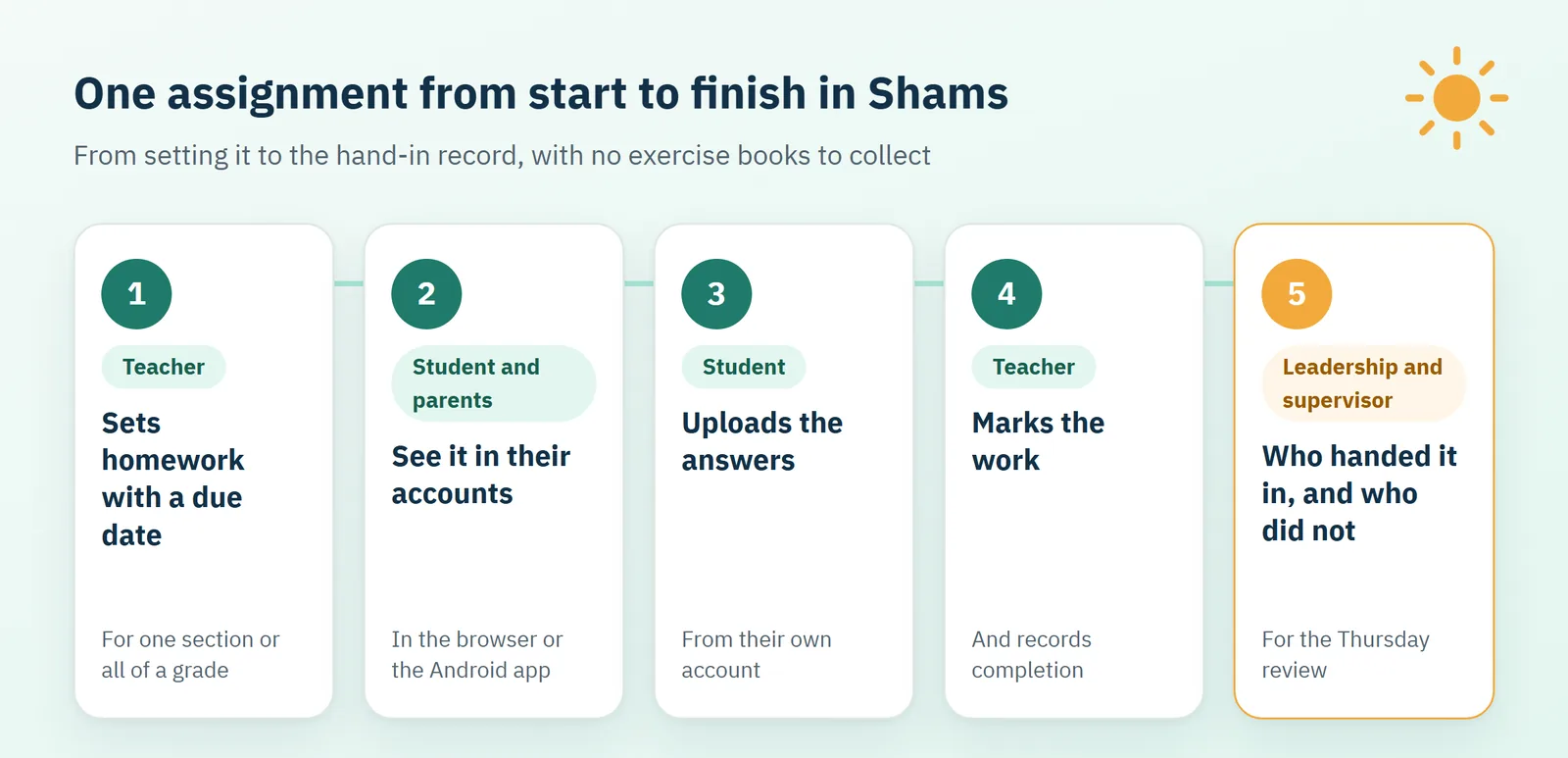
In Shams, a teacher sets homework for one section or for every section of a grade from "Give homework" at the top of their page, choosing its date, due date and mark, and attaching a file when needed. The assignment appears in the student's account, in the browser or the Android app, where the student uploads their answers, and it appears with its due date on the child's card in the parent's account, so parents no longer have to rely on their child alone to hear about it. The teacher then opens the marking screen, downloads each student's work and records its mark and completion status. The result is a clear record of who handed in each assignment and who did not, which school leaders and the supervisor can turn to in the Thursday review without collecting a single exercise book.
Try homework in the demo school
Open the demo school with the teacher account T62 to set homework for a section and choose its due date, then sign in as the student S221 to see his homework this term and the mark for each piece, and as his father P129 to see what reaches the parents. If you would like to show the system to your school's teachers, request a demo.