Late school fees: five habits that keep them down before the end of term
Late school fees are rarely solved at the end of term. Five habits to spot arrears early, remind parents tactfully and make paying easy, with templates.

In many private schools, the accountant only discovers how much in late school fees has built up when leadership asks for a total just before the end-of-term exams. By then only the worst options are left: calling parents in en masse, holding back report cards, or embarrassing a student who has done nothing wrong. Yet late payment rarely means a family is refusing to pay. Far more often, nobody reminded them at the right time that a fee instalment was due.
How can a school reduce late school fees?
The short answer: to keep late school fees down, give every fee instalment a written due date at the start of the year, provide each parent with a clear account statement, and send reminders a week before payment is due rather than after. Each week, the accountant reviews late payers by class, and the school accepts part payments and bank transfers so parents do not have to come in.
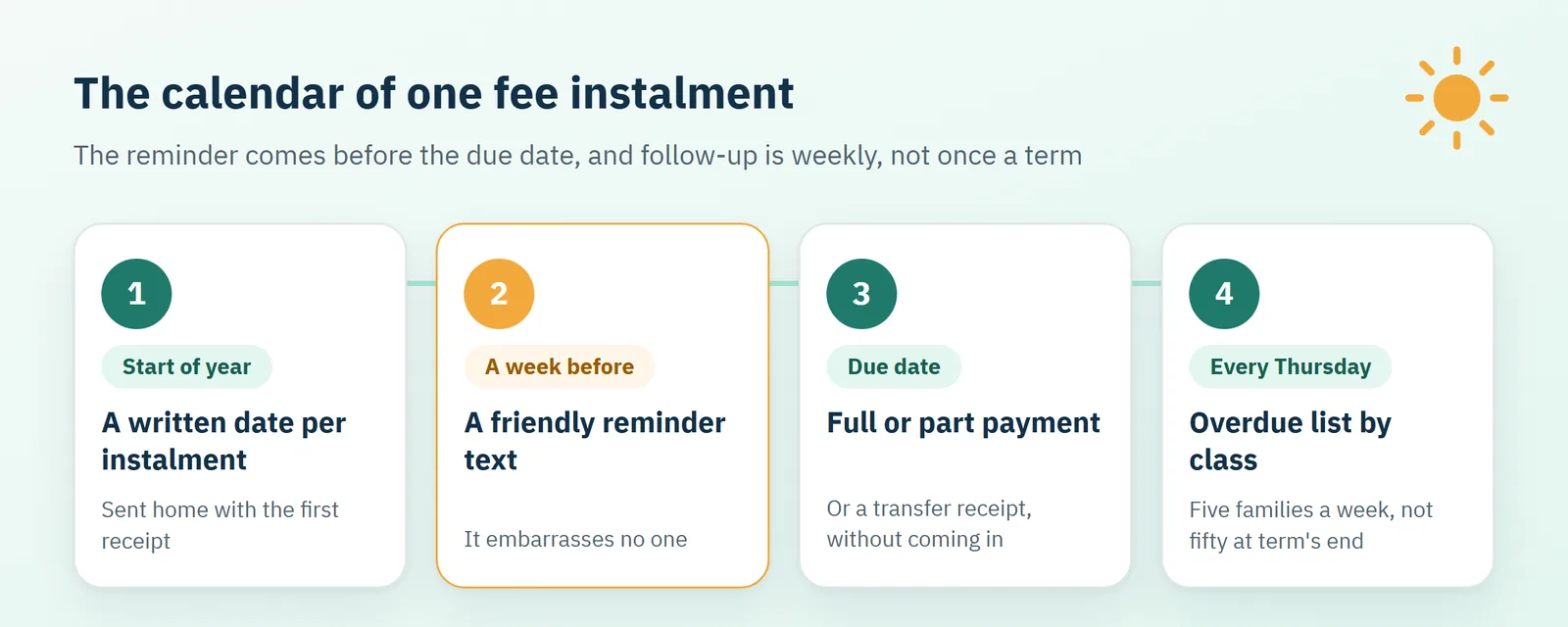
1. Give every instalment a written due date from the start of the year
"The second instalment is due mid-year" is not a due date. Write down the date each type of instalment falls due, and hand it to parents with their first receipt. Once both sides have the date in writing, there is no room for misunderstanding if a payment runs late.
2. Provide an account statement parents can follow
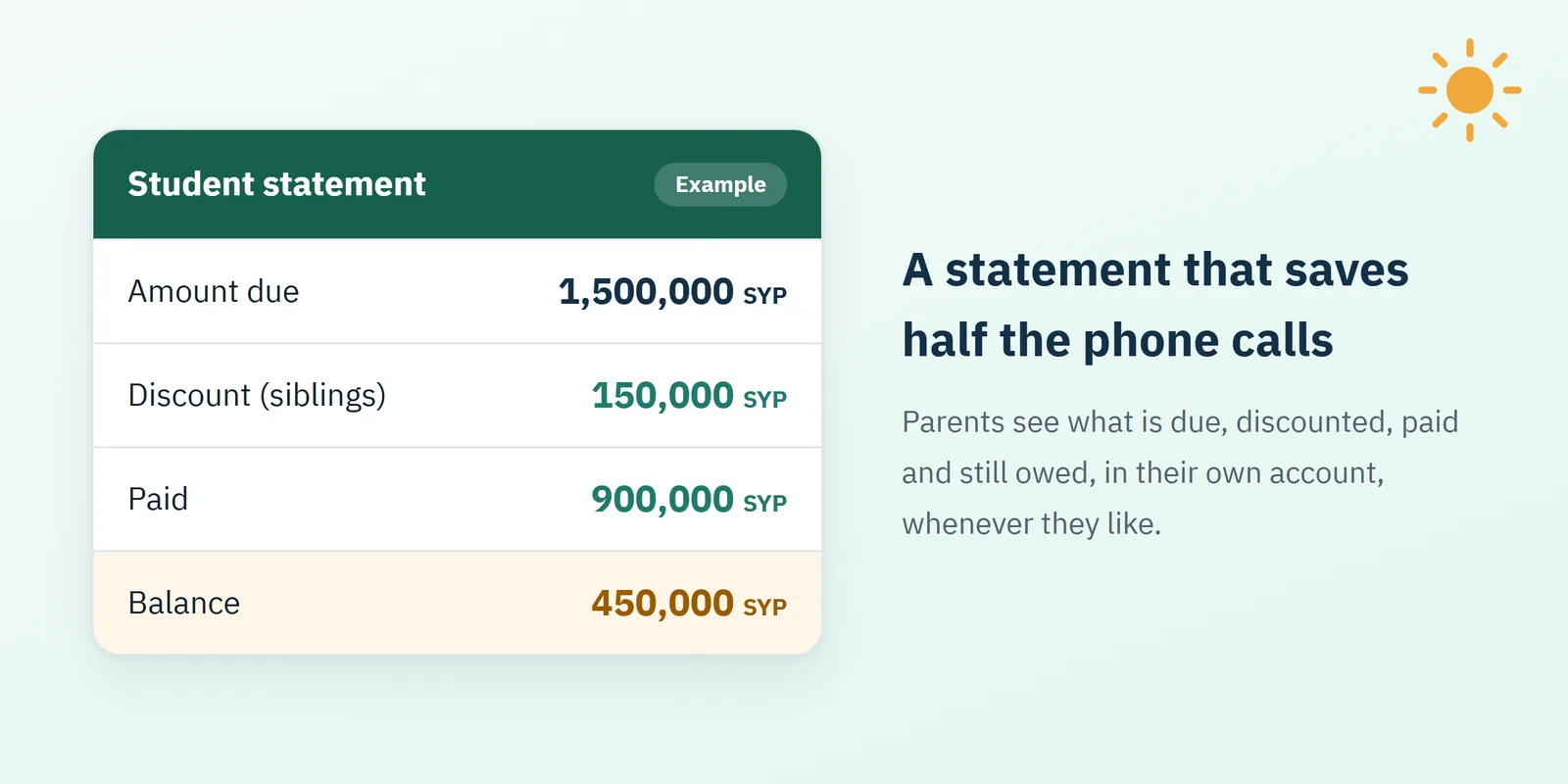
Many disagreements over fees begin because a parent does not know exactly what they have paid and what they still owe. A clear statement showing the amount due, any discount, what has been paid and what remains, which parents can check whenever they like, cuts out half the calls to the accountant.
3. Remind before the due date, not after
A text message that arrives a week before the due date embarrasses no one, and it helps many families pay on time. Send it after the payment is already late, and the conversation about fees becomes an awkward one. These two templates will get you started:
Reminder template before the due date
Your child's second fee instalment is due on 1/2, and the balance outstanding is [amount]. The school office.
Reminder template after the due date, without embarrassment
A reminder that your child's second fee instalment fell due on 1/2, with [amount] still outstanding. For any questions, please contact the accounts office. The school office.

4. Review late fees every week, not every term
All it takes is for the accountant to go through the list of late payers by class every Thursday. Contacting five families in the week they fall behind is far easier than chasing fifty at the end of term. Reviewing arrears class by class also shows you why they happen: when a whole class is behind, it usually means its parents were never told when the instalment was due.
5. Offer ways to pay that suit families
Not every parent can visit the school during working hours. Accept part payments and record them, and let parents upload a bank transfer receipt for the school to approve, so no one has to make the trip in person. The easier it is to pay, the fewer payments arrive late.
What should a school avoid when fees are late?
- Publicly naming or excluding students: a student with overdue fees is never singled out in front of classmates, and never barred from a lesson or an exam because of a fee.
- Asking the student for the money: fees are discussed with the parent, and only the parent.
- Forgetting discounts: discounts such as sibling discounts, discounts for the children of martyrs and scholarships are recorded from the start of the year, so a student never appears to owe money the school never intended to charge.
A weekly checklist for the accountant
- Every Thursday: go through the list of late payers by class and section.
- A week before each due date: send the reminder text to the parents in the class concerned.
- Every day: approve uploaded transfer receipts and record part payments.
- When a whole class falls behind: check that its parents were told the due date.
How does Shams make collecting school fees easier?
In Shams, the school defines its fee instalment types, amounts and due dates, assigns them to a whole class in a single step, and records discounts for each student individually. The accountant takes a payment in full or in part and prints the receipt, then opens the list of late payers by class and section and can send a reminder text straight from that list. Parents see their child's account statement in their own account and upload bank transfer receipts there, while the principal keeps an eye on total arrears by class from their dashboard.
Try the fees screen in the demo school
Open the demo school with the accountant account T66 and compare the statement of a family behind on its payments (P297) with that of a family that has paid the whole year's fees in full (P152), exactly as each parent sees it. If you would like to show the system to your school's accountant, request a demo.